
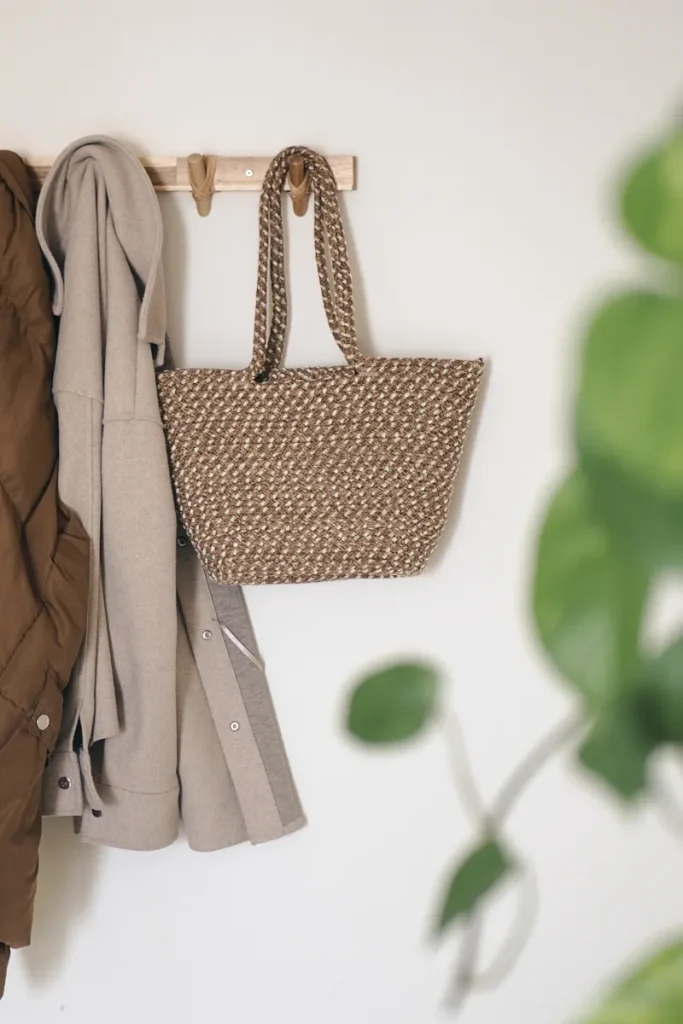
Every home seems to have one.
The chair covered in bags. The end of the kitchen bench piled with keys and mail. The collection of shoes beside the front door.
These aren’t necessarily signs that your family is messy. They’re often signs that your belongings are telling you exactly where a system is missing.
Welcome to the drop zone.
Why clutter gathers near the door
When we arrive home, we naturally want to put down whatever we’re carrying.
Keys, handbags, school bags, hats, shoes, parcels and paperwork all need somewhere to land.
If there isn’t an obvious home for them near the point where they’re used, the nearest flat surface becomes their home instead.
Rather than fighting this habit, build a system around it.
Watch what your household already does
Before buying hooks, baskets or a beautiful hallway console, observe where things naturally land.
Which door does everyone actually use?
Where do the kids drop their school bags?
Where are the keys usually left?
A successful drop zone should work with your household’s existing habits, not require everyone to suddenly develop completely new ones.
Give everyday items a home
Your drop zone might include:
Hooks for handbags and school bags.
A bowl or tray for keys.
A basket or rack for shoes.
A spot for hats and sunglasses.
A tray for incoming paperwork.
A charging point for devices.
Not every home needs all of these. Include only what regularly enters and leaves through that space.
Think about height
If children use the system, make it accessible to them.
A hook that is beautifully positioned for an adult, but impossible for a six-year-old to reach won’t solve the school bag problem.
Place children’s storage at their height, so they can participate independently.
Don’t let the drop zone become permanent storage
A drop zone should hold items that are actively moving in and out of the home.
It shouldn’t become a place for six months of unopened mail, shoes nobody wears or bags waiting to be donated.
Give the area a quick reset regularly, so it remains functional.
Make putting things away easier than dropping them
This is one of our favourite organising principles.
If hanging a school bag requires opening a cupboard, moving three things and reaching a high shelf, it’s probably going to end up on the floor.
If there is an empty hook exactly where the bag naturally lands, putting it away requires almost no additional effort.
Those tiny differences matter.
Work with your home, not against it
A well-organised home doesn’t rely on everyone remembering dozens of rules.
The environment itself should make the easiest choice the right choice.
Your drop zone doesn’t need to be large or Pinterest-perfect. It simply needs to catch the things that enter your home every day and give them a logical place to wait until they’re needed again.
Sometimes the smallest system can make one of the biggest differences.